Description
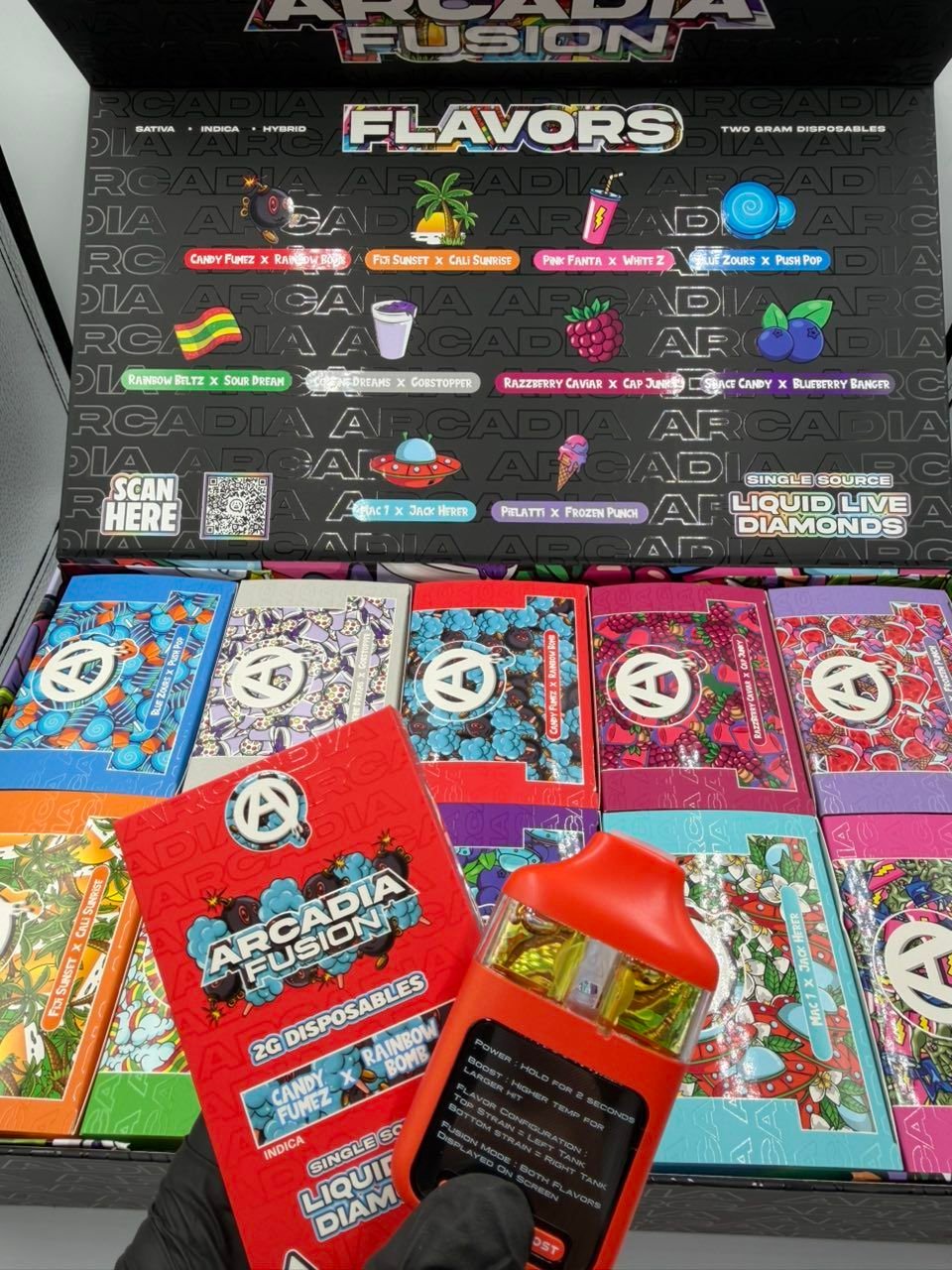
 ARCADIA FUSION V2 2G DISPOSABLE – Informational Overview
The ARCADIA FUSION V2 2G DISPOSABLE is a pre-filled, single-use electronic vapor device designed for convenience and portability. It typically integrates a built-in battery, a dual-gram capacity reservoir, and a pre-assembled heating element. Once activated, the device heats the internal material to produce vapor without requiring refilling or maintenance.
Many modern disposable devices use airflow-activated systems, meaning the user inhales to trigger operation. Additionally, dual-chamber designs allow two separate liquid or extract compartments to remain isolated until use, potentially offering combined or alternating flavor experiences.
Because the device is designed for single-use operation, it is usually disposed of once the internal battery or material is depleted.
Internal Components and Operating Mechanism
Disposable vapor devices are built around a compact, integrated system where all core components are pre-assembled inside a sealed body. The goal of this design is to allow immediate use without setup, maintenance, or refilling.
At the core of the device is a built-in lithium battery, which supplies power to the heating system. This battery is typically non-rechargeable in standard disposable formats, although some newer variations may include charging ports depending on the design.
Connected to the battery is a heating element (coil). When the device is activated—usually through an airflow sensor—the coil receives electrical energy and begins to heat up. This heating process is controlled to maintain consistent vapor production while minimizing overheating.
 The liquid or extract reservoir is positioned adjacent to the coil system. This reservoir holds the pre-filled material, which is gradually drawn toward the heating element through a wick or absorption medium. As the coil heats, the material is vaporized into an inhalable aerosol.
In dual-chamber systems, the internal structure is divided into two separate reservoirs. These chambers remain isolated until use, allowing different formulations or blends to be stored independently within the same device. When activated, airflow dynamics or internal channel design determine how the materials are vaporized—either alternately or in combination depending on the configuration.
An airflow sensor replaces the need for buttons in most modern designs. When the user inhales, the change in air pressure is detected by the sensor, which automatically activates the battery output to the coil.
Finally, a mouthpiece and airflow channel guide the vapor from the heating chamber to the user. These channels are engineered to regulate resistance, cooling, and vapor density before inhalation.
Activation Process and User Interaction
The operation of a disposable vapor device is designed to be straightforward, with minimal user input required. Most models rely on an automatic activation system rather than manual controls, reducing complexity during use.
When the user inhales through the mouthpiece, an airflow detection system registers the change in air pressure inside the device. This sensor sends a signal to the battery circuit, which then powers the heating element. As a result, the coil begins vaporizing the material held in the internal reservoir.
There is typically no need for buttons or external settings. Instead, the entire process is controlled internally and responds in real time to inhalation patterns. This allows for immediate activation and deactivation based on airflow—once inhalation stops, the sensor disengages and the heating cycle ends.
During operation, the device regulates power output to maintain consistent heating levels. This helps stabilize vapor production and prevents overheating of the internal coil. The airflow channel is also engineered to balance draw resistance, ensuring that vapor passes smoothly from the heating chamber to the mouthpiece.
In dual-chamber configurations, internal routing may determine how each reservoir is accessed during inhalation. Some designs alternate between chambers, while others allow simultaneous vaporization depending on the internal flow structure.
Because the system is fully sealed and pre-configured, there are no user-serviceable adjustments. Once activation begins, performance depends entirely on battery capacity and remaining material within the reservoir. When either is depleted, the device stops functioning and is intended for disposal.
Performance Characteristics and Limitations
Disposable vapor devices are engineered for short-term, self-contained use, and their performance is directly tied to the capacity of both the internal battery and the pre-filled reservoir. As a result, output gradually declines over time rather than remaining constant throughout the device’s lifespan.
One of the primary performance factors is battery discharge behavior. Since the battery is not actively managed by the user, voltage output decreases as energy is consumed. This can lead to a reduction in vapor density or consistency during the later stages of use. Some designs attempt to regulate this through internal circuitry that stabilizes power delivery, but limitations still exist due to the compact nature of the system.
Another factor is material depletion within the reservoir. As the internal liquid or extract is vaporized, absorption efficiency may vary depending on remaining content and wick saturation. Toward the end of the device’s lifecycle, vapor production may become less uniform as the supply diminishes. ARCADIA FUSION V2 2G DISPOSABLE
Temperature regulation is also inherently constrained. Because disposable systems are sealed and simplified, they typically rely on preset heating profiles rather than adjustable controls. This ensures consistent operation under normal conditions but limits customization for different user preferences or environmental conditions. ARCADIA FUSION V2 2G DISPOSABLE
Environmental conditions such as ambient temperature and airflow resistance can also influence performance. In colder environments, battery efficiency may decrease slightly, while airflow variability can affect how quickly vapor is generated and delivered. ARCADIA FUSION V2 2G DISPOSABLE
Ultimately, these limitations reflect the trade-off between convenience and longevity. The integrated, single-use structure prioritizes portability and simplicity, while inherently restricting extended performance tuning or long-term durability. ARCADIA FUSION V2 2G DISPOSABLE
Usage Lifecycle and End-of-Life Handling
 Disposable vapor devices are designed with a finite operational lifecycle determined by battery capacity and internal reservoir volume. Once either of these components is exhausted, the device is no longer functional and cannot be restored through maintenance or refilling. ARCADIA FUSION V2 2G DISPOSABLE
During typical use, performance gradually declines as internal resources are consumed. This includes reduced vapor output, changes in draw consistency, and eventual cessation of activation when the airflow sensor can no longer trigger sufficient power delivery from the battery system. ARCADIA FUSION V2 2G DISPOSABLE
At the end of its lifecycle, the device is considered fully depleted. Most designs do not support disassembly or replacement of internal components, as the structure is sealed for safety and manufacturing efficiency. Because of this, continued operation beyond depletion is not possible. ARCADIA FUSION V2 2G DISPOSABLE
From a handling perspective, end-of-life devices are generally treated as electronic waste due to the presence of a lithium-based battery. Proper disposal methods depend on local electronic recycling guidelines, which are intended to reduce environmental impact and recover recyclable materials where possible. ARCADIA FUSION V2 2G DISPOSABLE
In dual-chamber systems, both internal reservoirs are depleted independently over time, but the device is still considered expired once either battery capacity or overall vapor production is no longer sufficient for operation. ARCADIA FUSION V2 2G DISPOSABLE
Safety Considerations and Responsible Handling
Disposable vapor devices are compact electronic products that combine a battery, heating element, and sealed material reservoir in a single unit. Because of this integrated design, safe handling is mainly determined by correct use conditions and awareness of the device’s limitations. ARCADIA FUSION V2 2G DISPOSABLE
One of the primary safety considerations involves the internal lithium-based battery. These batteries are stable under normal operating conditions, however they can be sensitive to physical damage, excessive heat, or improper disposal. For this reason, devices are typically designed as sealed units to reduce the risk of tampering or accidental exposure to internal components. ARCADIA FUSION V2 2G DISPOSABLE
Heat management is another important factor. During operation, the heating element reaches elevated temperatures to vaporize the internal material. The system is engineered to contain this heat within the internal chamber, ensuring that external surfaces remain within expected safety thresholds during normal use. However, continuous or abnormal usage patterns may affect temperature stability. ARCADIA FUSION V2 2G DISPOSABLE
Airflow systems are calibrated to maintain consistent operation and reduce the risk of overheating. When airflow is obstructed or inconsistent, the device may automatically reduce or stop output to maintain internal balance. This built-in response helps protect the heating element from excessive strain. ARCADIA FUSION V2 2G DISPOSABLE
Because the device is fully sealed, there are no user-serviceable parts. Attempting to open or modify the structure can compromise both mechanical integrity and electrical safety. The enclosure is designed to maintain isolation between the battery, heating system, and reservoir throughout the device’s lifespan. ARCADIA FUSION V2 2G DISPOSABLE
Storage conditions also play a role in safe usage. Exposure to extreme heat, direct sunlight, or high humidity can affect battery stability and material consistency over time. Keeping the device in moderate environmental conditions helps preserve its intended performance characteristics. ARCADIA FUSION V2 2G DISPOSABLE
Finally, once the device reaches the end of its lifecycle, it should be handled as electronic waste due to its battery content. Proper disposal practices are important to reduce environmental impact and ensure safe handling of electronic components after use. ARCADIA FUSION V2 2G DISPOSABLE
zoritoler imol –
I’ve been browsing on-line greater than three hours today, but I by no means found any interesting article like yours. It is pretty price sufficient for me. In my view, if all webmasters and bloggers made just right content material as you did, the net shall be a lot more useful than ever before.